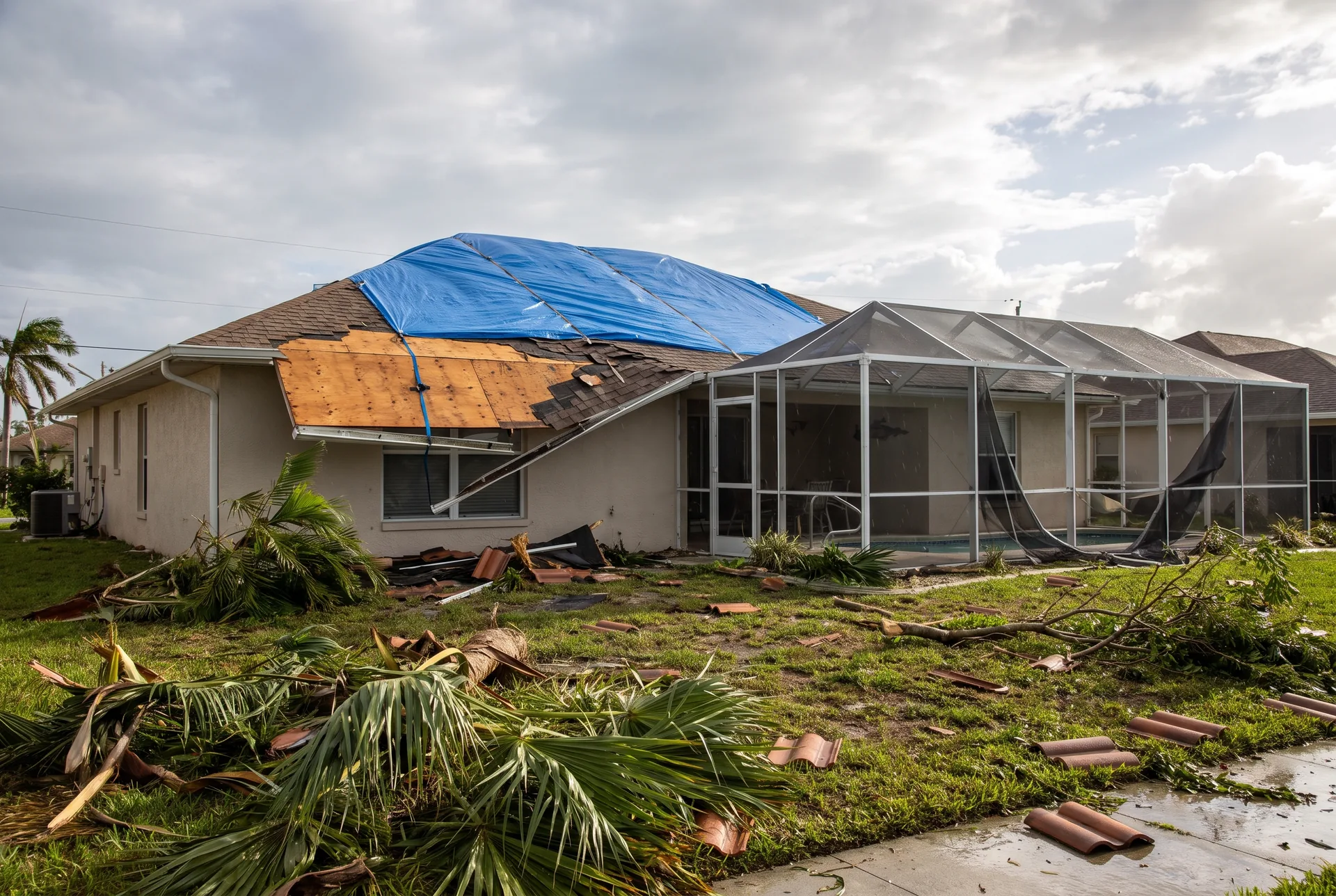
Ian in 2022, Helene and Milton in 2024 — Cape Coral has had enough practice at this. Here is the order that works, from people who've tarped the same streets three times.
The first 72 hours
Stay off the roof
Wet tile and shingle are slick, decking may be compromised, and power lines may be down. Look from the ground and from inside; that's enough to start.
Stop the water
Move what you can, put buckets and plastic under drips, and call for a tarp. A properly fastened dry-in is a few hundred dollars and it's what your policy expects you to do to prevent further damage. Keep the receipt.
Photograph everything
Every stain, every drip, the yard full of tiles or shingles, the pool cage, the neighbor's debris on your roof. Date-stamped phone photos are fine. Do it before anyone cleans up.
Write down what you saw
When the wind peaked, when the leak started, what you heard. Two months from now, nobody remembers.
The first two weeks
Get a real inspection
A licensed roofer walks the roof and the attic, photographs the damage, and writes a dated report describing what happened and what it takes to fix. That report is yours whether or not you file. Ours is free.
Decide about a claim — yourself
Look at your hurricane deductible: it's usually 2% to 5% of your dwelling coverage, so on a $400,000 policy it's $8,000 to $20,000. A $3,000 repair isn't a claim. A stripped roof section and wet decking across the attic is. Your agent can tell you what a claim does to your future premiums. This is your decision — and by law, not the roofer's.
Know the rules
- Roofers can't solicit claims. Florida Statute 489.147 prohibits roofing contractors from advertising or knocking on your door to get you to file, from paying or waiving your deductible, and from offering gifts or rebates for a claim. A roofer who offers to "handle your deductible" is telling you something.
- No assignment of benefits. Since January 1, 2023, new policies don't allow you to sign your claim over to a contractor. You stay in control of your claim and your money.
- Licensed only. Florida requires a state-licensed roofing contractor (a CCC license) to pull the permit and do the work. Look up the license number at myfloridalicense.com before you sign anything. After Ian and Milton, out-of-state crews took deposits and left.
- The 25% rule has changed. If your roof was permitted after March 1, 2009, only the damaged section has to be repaired to current code, however big it is (SB 4-D, F.S. 553.884). If it's older, damage to more than a quarter of the roof in a year means the whole roof must be brought up to code — which is why many older roofs end up replaced after a storm.
If you file
The adjuster visit
Your carrier sends an adjuster. We meet them on the roof, walk the damage with the photos, and answer questions about the roof's age and condition honestly. Creased shingles and displaced tile look different from a roof that was already failing; the photos from day one are what settle it.
The scope and the estimate
The carrier approves a scope. We write our estimate to that scope and to current code, with the ordinance-and-law items (sealed deck, secondary water barrier, re-nailing, attachment) itemized so the carrier can see them — most Florida policies carry 25% ordinance-and-law coverage for exactly this.
Supplements
If tear-off reveals damage nobody could see — rotten decking, wind damage under intact tile — we document it and submit a supplement. We don't pad the first estimate to avoid one.
Payment
The carrier pays you (and your mortgage company, if there is one), less your deductible and depreciation if your policy is actual-cash-value. You pay us. There's no assignment, no middleman.
If you don't file
Then it's a repair or a replacement like any other — written price, permit, code-built, done. Financing is available, and for older homesteaded homes the My Safe Florida Home program can contribute to the wind-mitigation parts of a new roof.
Nothing on this page is advice to file or not file a claim. Florida law (F.S. 489.147) prohibits roofing contractors from soliciting claims, and we don't. It describes how the process works so you can decide.
Related questions
Should I sign with the roofer who came to my door after the storm?
Not on the doorstep. Take the card, look up the license at myfloridalicense.com, check that it's a CCC roofing license and not a general contractor or nothing at all, and get a second inspection. Florida law prohibits roofers from soliciting claims, so a doorstep pitch about your insurance is itself a red flag.
The adjuster denied it as wear and tear. What can I do?
Review the report against your photos. If you believe the storm caused the damage, a licensed public adjuster or an attorney is the path — not your roofer, who isn't allowed to negotiate your claim. Sometimes the adjuster is right; an old roof that lost tabs was going to.
How long do I have to file a hurricane claim in Florida?
One year from the date of loss for a new claim under current law, and 18 months for a supplemental claim. Check with your carrier; the rules have changed more than once.
Will a claim raise my rates?
Often. Ask your agent before you decide. That's part of why the deductible math matters — a small repair paid out of pocket keeps a claim off your record.
Does insurance cover the code upgrades?
Usually, through ordinance-and-law coverage (most Florida policies include 25%). The upgrades the code now requires are itemized on our estimate so the carrier can see them.
What if my roof was replaced after Ian by a company that's gone?
We inspect and photograph what's there and tell you honestly whether it's sound. If the workmanship is bad, repair or replacement is the same process as any other — the warranty you were promised likely died with the company.